

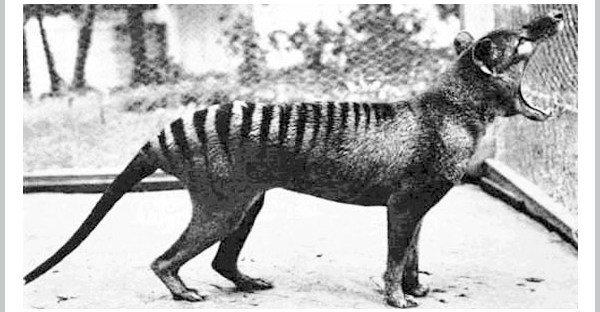
A Cryptid Well Alive: New footage of the Mainland Thylacine:
New footage of the allegedly extinct Mainland Thylacine has recently emerged, adding to the long list of reports and images already compiled from past decades. The most famous Thylacine, better known as the Tasmanian Tiger or Tasmanian Wolf, is neither a tiger nor a wolf, but a large carnivorous marsupial. The last specimens officially died in a zoo in Hobart in 1936 and the Thylacine has been declared extinct since, while on the Mainland, it is believed they have disappeared around two thousand years ago.
However, this mysterious cryptid shows resilience with a continuous flow of regular reports of sightings, including a few rare, yet sometimes clear photos. This family of cryptids is particularly interesting for me, especially since my close encounter with a similar animal in the Gondwana World Heritage Rainforest of NSW, previously described on SCENIC. With confirmation from Original Elders, I concluded that they were the Bunyip of ancient legend and colonial lore, and they account for the majority of the hundreds of reports of large black panther-like animals roaming the Australian bush.
But after doing research, I couldn’t definitely settle on any of the species proposed by scientists from the fossil record. The confusion was mainly caused by the muzzle of the animal I observed, which was long and thin, and when it opened its mouth wider than a 120 degree angle, with rows of thin teeth, I recognized a Thylacine, or something closely resembling one in shape, size and behavior. But its size was closer to that of the Thylacoleo Carniferex or Marsupial Lion, a close relative of the Thylacine, than to that of a smaller Wakaleo, both known from the fossil record and considered extinct since millennia.
The other doubt arose from the fact that the large carnivorous marsupial I saw at close range seemed to be all shiny black with stripes of dull black on its back, like those of a Thylacine. Yet, most photos and footage from Thylacines show fairly clear tawny furs. However, Dingos are also thought to be generally reddish or yellowish, but the region where I had my encounter hosts a rare population of black dingos, and that is what my hosts there thought I had met; but I know what I saw and it was not a dingo, rather clearly some kind of Thylacine, by its typically marsupial appearance and behaviors.
Anyhow, it is not impossible that certain local populations or a subspecies of those cryptids may be black, given the hundreds of reports in Australia mentioning black ”panthers” or large black feline-like predators. As a matter of fact, at least one alleged photo of a Thylacine shows a black specimen, in the short documentary posted below.
But first, this recent clear footage from a long time Thylacine tracker is undeniable evidence that Thylacines still roam Mainland Australia.
Rachel Hybrid wrote:
”Dear Sunbow, It’s been quite a while since we connected, I do hope this email finds you well and good and all things going smoothly for you… I just saw this video come up on my YouTube feed and thought of you straight away! I hope all is well with you and our brothers and sisters our beloved sasquatch people.. and ancient ones.. Many blessings to you Sunbow. Love from Rachel Hubbard white star shining they called me.”
After watching this newly captured exceptional footage of an allegedly ”extinct” cryptid, I watched this 13 minute research video on the Thylacine, displaying an amazing collection of photos, from nearly 1300 compiled reports. It also addresses the Thylacine Project, a scientific research aimed at bringing back the Thylacine through genetic experiments, that might possibly account for at least one sighting filmed near Melbourne, which we reported.
In the end, who really knows what roams out of sight in the wild and how many species are left to discover. With a limited amount of evidence and hardly any research on such cryptids that are not supposed to exist anymore, there is plenty of room for speculation and still, witnesses accounts remain the best source of information. This shows how much science has left to learn.
Although we do not consider Hairy Humanoids as cryptids, we know they know them and all the secrets of Nature better than us, and they are all part of the mysterious explained we have left to explore. In fact, when I had my encounter with the Bunyip, it was supervised by a Yowie Elder, as I wrote in my account. Thanks to our readers for your interest and support!…


this is not quoll I think quoll are not digitigrade .clearly thylacine is .it look like injury on left leg but pause and left the right leg so was not hurt .the mange fox has thin in the hair and thylacine look black in thermal video .i still skeptic no stripe it look like it’s not that long
LikeLiked by 1 person
quoll is digitigrade so I was wrong the video shows it hoppying but see it clearly the mammal first hind left leg first then right leg at the back only one leg on the ground it’s not a injured allso it lift the right leg very up that will hurt if it was injured when it pause in the comment ambiguous word even said that.allso devil tail is small the quoll look like thylacine but it’s not same size you can not know by the video .as why did they not find it in Australia all this time because it’s night hunter if it was a day hunter probaly not .
LikeLiked by 1 person
all skeptic rush to judgement clear did not do there homework the thylacine eyes are line with there ears it was on comment of ambiguous world I saw that by my seft but after saw comments on ambiguous I check again use wolf and again quoll fox devil dingo at first the devil clearly like thylacine .quoll and fox and wolf dingo were not and check again and they were. I really do not were ears start but have to accept scientist finding for now because I not a scientist .on ankle digitigrade foot any won cliam that they are big are blind even for thylacine they are small I do not need the thing that ambiguous world use to read the ankle .even in dog and fox it can be small because of camera tricky tricky I saw a report on that .on missing Persian cat tail on fox even on ambiguous old camera allways see Persian tail for fox only mange won are missing the picture on thylacine round ear is clear on video the thermal ears.
LikeLiked by 1 person
the left leg they cliam it is injured I thought that first when I saw it but second look it look like it was not injured it look liked it took 4 step on the zoom the leg look like it is violent step there is no pause the thermal on front leg and back leg is the same color .the skull the forehead you can see the ear are not big it has to be marsuperial .on the right leg no good footage only one step it’s not in the same line .if was injured would be in the same line it look like how mammal walk even with a hopping walk .only 2 leg on the ground at once the front left leg and the left back leg
LikeLiked by 1 person